• Search
  • Helpdesk
  • Sales contact

Infography: 7 lesser known advantages of eCOA over COA

Last updated: June 24, 2024

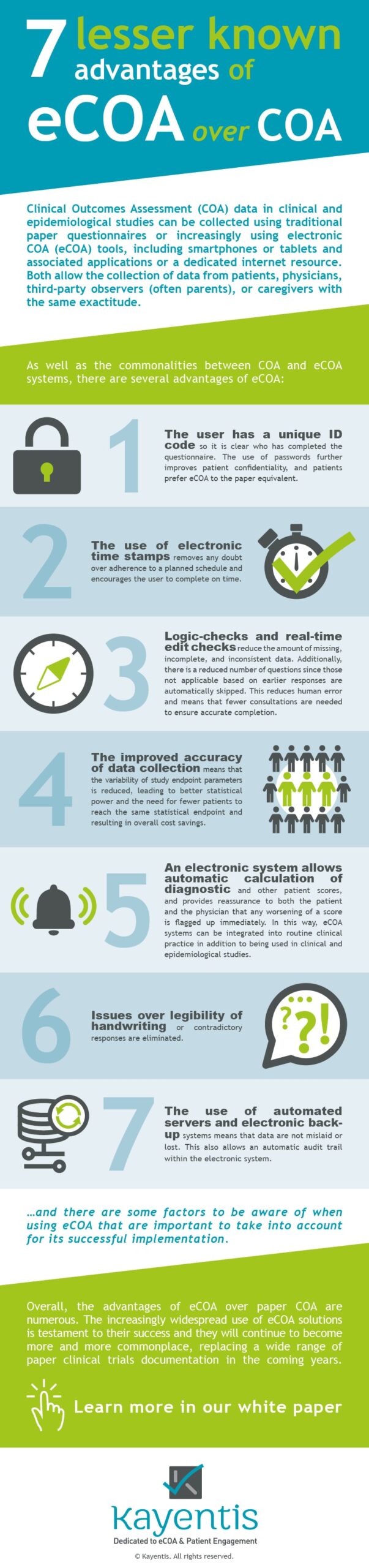
Advantages of eCOA: Clinical Outcomes Assessment (COA) data in clinical and epidemiological studies can be collected using traditional paper questionnaires or increasingly using electronic COA (eCOA) tools, including smartphones or tablets and associated applications or a dedicated internet resource. Both allow the collection of data from patients, physicians, third-party observers (often parents), or caregivers with the same exactitude.

As well as the commonalities between COA and eCOA systems, there are several advantages of eCOA…

To download the infography, click here:

[tag url=”https://kayentis.com/wp-content/uploads/2017/05/kayentis-infography-ecoa-vs-coa.pdf” event=”click onco infography”]
Kayentis infography advantages of eCOA

The user has a unique ID code so it is clear who has completed the questionnaire. The use of passwords further improves patient confidentiality, and patients prefer eCOA to the paper equivalent.
The use of electronic time stamps removes any doubt over adherence to a planned schedule and encourages the user to complete on time.
Logic-checks and real-time edit checks reduce the amount of missing, incomplete, and inconsistent data. Additionally, there is a reduced number of questions since those not applicable based on earlier responses are automatically skipped. This reduces human error and means that fewer consultations are needed to ensure accurate completion.
The improved accuracy of data collection means that the variability of study endpoint parameters is reduced, leading to better statistical power and the need for fewer patients to reach the same statistical endpoint and
resulting in overall cost savings.
An electronic system allows automatic calculation of diagnostic and other patient scores, and provides reassurance to both the patient and the physician that any worsening of a score is flagged up immediately. In this way, eCOA systems can be integrated into routine clinical practice in addition to being used in clinical and epidemiological studies.
Issues over legibility of handwriting or contradictory responses are eliminated.
The use of automated servers and electronic back-up systems means that data are not mislaid or lost. This also allows an automatic audit trail within the electronic system.

Interested by the differences between eCOA and COA? Please download our white paper regarding the pros and cons between COA and eCOA.

Follow us on social media
Subscribe to our newsletter
About the author
Meet us at the following events

ACDM 2026

MAR 15-17 2026 • Berlin, Germany
Booth #22 ACDM26 15-17 March 2026

C-PATH 2026

APR 16-17 2026 • Washington, D.C. USA

2026 Precision in Clinical Trials

APR 30 - MAY 1 2026 • Boston, MA, USA
Booth #3 Precision In Clinical Trials Summit | April 30 - May 1 - Boston

OCT Europe 2026

MAY 6-7 2026 • Barcelona, Spain
Booth #59 16th Annual Outsourcing in Clinical Trials Europe 2026 - Arena International

OCT East Coast 2026

MAY 12-13 2026 • New Brunswick, NJ, USA
Booth #7 17th Annual Outsourcing in Clinical Trials East Coast 2026 - Arena International

Patients as Partners 2026

MAY 19-20 2026 • London, UK
Patients as Partners EU

PCMG 2026

JUNE 16-17 2026 • Berlin, Germany
Register For PCMG26 Updates - PCMG 2026 Annual Assembly